
SEO for Developers · Business Tips
What is AEO?
Answer engine optimisation is the same honest SEO with one extra rule: the answer comes first, in plain words, and the rest of the page proves it. Here is what that means, where the answers show up, and the six steps I run on a page.

What is AEO, in plain words
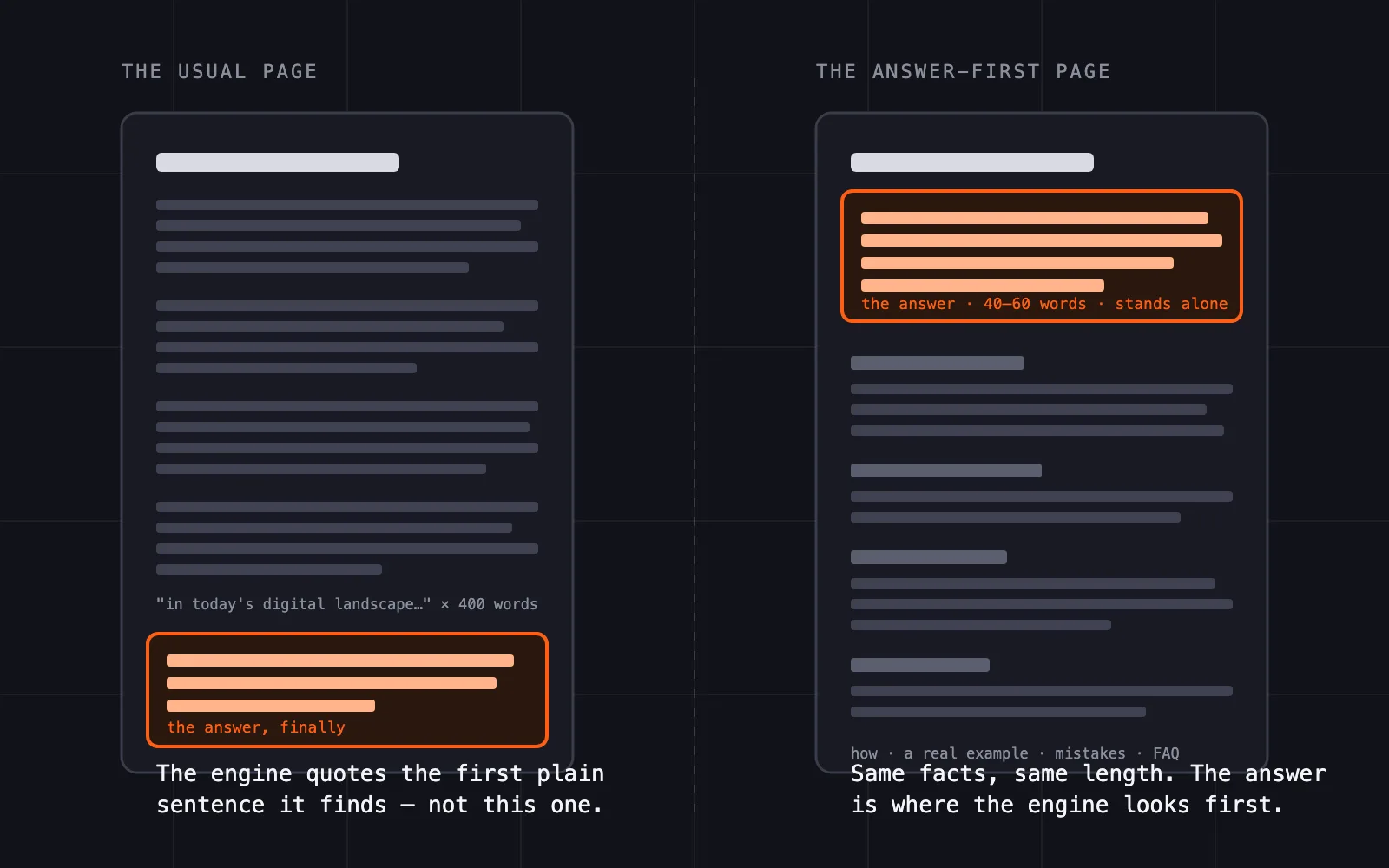
What is AEO? AEO — answer engine optimisation — is writing and structuring a page so that an answer engine (Google's AI Overviews and featured snippets, ChatGPT, Perplexity, Gemini) can lift the answer straight out of it and credit your site: the answer comes first, in 40–60 plain words, and the rest of the page proves it. It is ordinary SEO with that one extra rule.
So what is AEO for a business owner? It is the difference between a page that ranks and a page that gets quoted. When someone types "how long does a website redesign take" into an answer engine, the engine does not send them to ten blue links; it writes a paragraph and names two or three sources. AEO is the work of being one of those sources.
It is not a separate service. It works best as part of the SEO you already do, because one audit covers both. I fold it into every page my team and I write, and I'll show you exactly how below.
Where the answers show up
Four places, and they behave the same way. Google AI Overviews sit above the normal results for questions Google thinks it can answer, with source links under the paragraph; Google's own I/O 2026 announcement says an Overview now flows into AI Mode, the conversational tab, so the same sources carry into the follow-up questions. Featured snippets are the older cousin: one page's paragraph or list lifted into a box at the top. ChatGPT, Perplexity and Gemini write the answer and cite the pages they read.
What they have in common is the part that matters for your site. Each one reads a page, finds the passage that answers the question most directly, and quotes or paraphrases it with a link. They are not reading your whole page and forming an opinion. They are looking for the block that already is the answer.
That changes one thing about how a page is written and nothing about what it is built on. A page still has to be indexed (listed in Google's index — Search Console → Pages shows which are), fast, readable without JavaScript, and honest. Those are the SEO basics my team checks first — the free SEO checker on this site runs the same list for you.
How I do it: the answer-first page, step by step
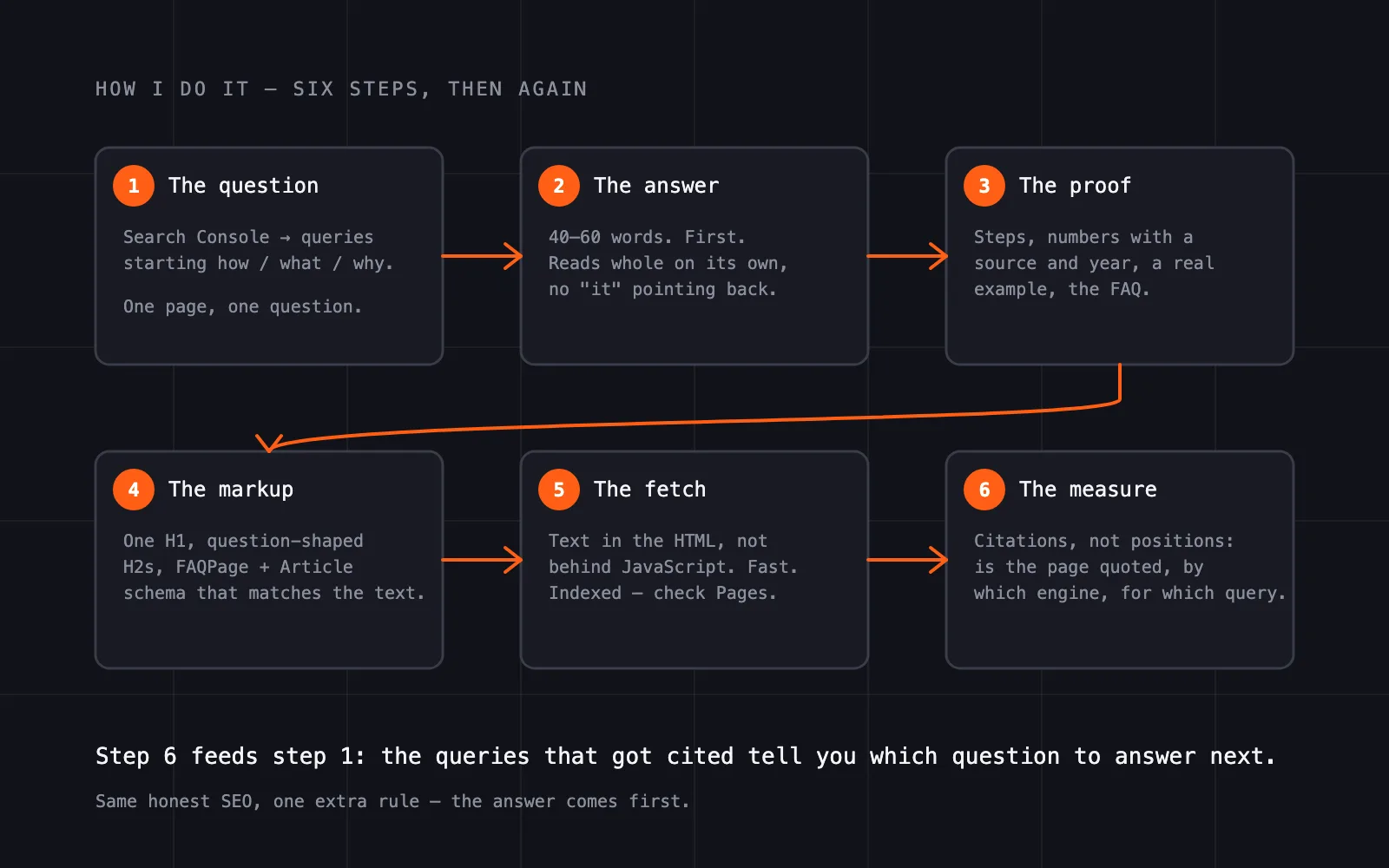
Six steps, in this order — and the sixth feeds the first. This is the process the SEO team and I run on a page.
If you can only do one of the six, do step two on the page that already gets the most visits: rewrite its first sixty words into the answer. Markup is second. Tools are last — they measure the work, they don't do it.
- Find the question people actually type — Search Console → Performance → Queries, filtered to queries starting with how, what, why or is. Those are the questions an answer engine is already fielding for your site. One page answers one question — if a page is trying to answer four, it will be quoted for none.
- Write the answer in 40–60 words, first — Under the H1, before anything else: a paragraph that answers the question completely and reads whole on its own. No "it" pointing back at the heading, no "as we'll see below". If a stranger read only that paragraph, they'd have the answer. This is the block the engine lifts.
- Prove it underneath — Numbered steps for a how-to, a table for a comparison, a real example with a number and where the number comes from, and an FAQ of the neighbouring questions. The proof is what makes an engine trust the answer enough to cite it — and what makes a person stay after they've read it.
- Mark it up so the markup matches the text — One H1 that is the question, H2s shaped like questions, and FAQPage and Article schema — the hidden code that tells an engine what is on the page — repeating what is visible, never questions that aren't there. The schema generator on this site writes the block; the SERP preview shows you the title and description the way Google trims them.
- Make sure the engine can fetch it — The answer has to be in the HTML, not rendered by JavaScript after the fact; the page has to load fast on a phone; and it has to be indexed — Search Console → Pages tells you. A page that isn't indexed cannot be cited, however well it's written. The speed check covers the first two.
- Measure citations, not positions — For this work a position is the wrong number. The question is: is the page quoted, by which engine, for which query. The team tracks that with the AI-visibility check in DevsKing, the SEO tool company I founded, across ChatGPT, Gemini and Perplexity, alongside Search Console. The queries that got cited tell you which question to answer next — back to step one.
The honest part: what I can show you, and how I measure it
My team and I have hundreds of websites completed, and every page we write now goes in answer-first. The SEO projects whose clients agreed to be named are on the projects page, each one a build where SEO basics were part of the work. Every number I publish has a real page behind it, never an invented one.
What I can tell you is what the team watches: for each page, whether it appears as a source in an AI Overview or a Perplexity answer for its question, and whether the question-shaped queries in Search Console grow. Each result is reported against the page it came from, so you can see exactly what moved.
What I have learned from doing this on my own pages: the slow part isn't the writing. It's agreeing what the one-sentence answer actually is. That argument is the work, and it takes longer than the page.
What to get right about AEO, so people quote your page
Four things I check first when a site comes in for an audit, and the fix for each.
- The answer in the page, not only in the markup. FAQ schema works when the page really answers the question. The markup promises a question and answer, the page delivers both, and the engine learns to trust the markup.
- The answer at the top. If four hundred words of "in today's digital landscape" come before the answer, the engine quotes the first plain sentence it finds — which is the wind-up, not the answer. So the answer goes first.
- The basics before AI SEO tools. A page that isn't indexed, or loads its text with JavaScript, can't be cited by anything. Check Search Console → Pages first; then the tools have real work to measure.
- Citations, not a position. An answer engine has no position to promise. For this work the number to watch is citations: is the page quoted, and for what.
SEO vs AEO: same job, one extra rule
If you already do SEO properly, AEO adds one habit and changes one measurement. Everything else stays.
| What changes | SEO | AEO |
|---|---|---|
| The goal | A page ranks for a query | A page is quoted as the source for a question |
| The unit | A keyword | A question, with one answer |
| Where the answer sits | Anywhere on the page | First, in 40–60 words, standing alone |
| What proves it | Links, content, speed, structure | The same — plus the proof directly under the answer |
| How it's measured | Position, clicks, impressions | Citations: quoted or not, by which engine, for which query |
| Who does it | The same team | The same team |
Answer first. Then prove it. The engine quotes the block that already is the answer; the rest of the page is what makes it trust the block enough to name you.
Read next
The service pages this post belongs to, and the tools used in the steps.
- SEO services — done for you
- Freelance SEO consultant — the plan
- Technical SEO services
- Free SEO checker
- Schema generator
- SERP preview
If you'd rather have someone do this
Run the free SEO checker on the page you'd most like to be quoted for, then bring the result to a call. If you'd rather have someone rewrite the page answer-first and track whether it gets cited, that's what I do — the SEO consultant page says how, and SEO services is the done-for-you version. The whole method, all nine questions, is in the AEO guide.
Questions
Questions this post answers
How do you get your website cited by AI search engines?
- Answer one question per page, in the first 40–60 words, and prove it underneath with steps, a real example and an FAQ. Make sure the page is indexed, fast, and readable without JavaScript, and mark it up with schema that matches the visible text. The engines cite the page that answers most directly, not the page with the most words.
How do you optimise content for Google AI Overviews?
- The same way as for any answer engine: the question as the H1, the answer first and self-contained, the proof below, and FAQPage schema for the neighbouring questions. There is no separate submission or tag for AI Overviews. Check Search Console → Pages to confirm the page is indexed before anything else.
How do you measure AI search visibility?
- By citations, not positions: for each page and its question, is the page quoted as a source, by which engine, and how often. The team runs an AI-visibility check across ChatGPT, Gemini and Perplexity for that, and watches the question-shaped queries in Search Console alongside it.
Does E-E-A-T matter for AI search?
- Yes, in the plain sense: an engine cites pages it has reason to trust, and the signals are the same ones people use — a named author with a track record, numbers with their sources, a real example, and a site that states its scope plainly. Those are the signals my team builds into every page.
How is AI changing SEO?
- The basics are unchanged: a page still has to be indexed, fast and worth reading. What changes is the unit of work — from a keyword to a question with one clear answer — and the measurement, from a position to whether the page is quoted. Sites that wrote for people first have the least to change.