
website care plan
Website care plans that keep your site updated, backed up and watched
- Core, plugin and theme updates every week, each one after a backup
- Each update rehearsed on a staging copy before going live
- Off-server backups, plus a restore tested on a spare copy
- Monitoring of uptime, logins and file changes, with alerts to a person
- The open doors the WordPress site check finds, such as exposed usernames and XML-RPC, closed
- Small fixes and content changes inside the agreed limit
- One report a month: what was updated, what was caught, what comes next
Overview
What a website care plan covers
A site's upkeep comes down to three jobs: backups, updates and someone watching. A website care plan puts all three under one written scope. Every week the site is backed up, and only then updated. The backups live away from the server, and a restore gets tested. An alert goes to a person, not just a log, and a report lands every month.
You don't keep a backup tool in one place, a monitoring service in another and a developer's number for emergencies somewhere else. You get one scope, one monthly report and one team to message. The people who updated a plugin on Tuesday are the same people who know when the last good backup was taken.
WordPress and WooCommerce sites, Next.js sites and Node apps all go on the same kind of plan. What changes between them is the list of things that get updated.
- Weekly updates, each run after a fresh backup and tried on a staging copy first
- Backups stored off the server, with a restore proved on a spare copy
- Uptime, logins and file changes watched, and every alert seen by a person
- Small fixes and content edits, within the limit we set together at the start
- Every month, a report listing the updates made, the problems caught and the work ahead
What a scope from me looks like
A sample care plan, line by line
Included
- Core, plugin and theme updates every week, each one after a backup
- Each update rehearsed on a staging copy before going live
- Off-server backups, plus a restore tested on a spare copy
- Monitoring of uptime, logins and file changes, with alerts to a person
- The open doors the WordPress site check finds, such as exposed usernames and XML-RPC, closed
- Small fixes and content changes inside the agreed limit
- One report a month: what was updated, what was caught, what comes next
Phase two
- Moving the site to a new host
- New features or integrations
- A full speed pass once the site has slowed down
Not doing
- Wix or Squarespace sites, which give no access to the files
Every care plan starts life as a written scope you sign. Ask for something outside it and you get a quote for that job first, before anyone touches it.
Each month's report lists the work done against these lines. So you can always see what the plan actually did for your site.
Process
How a care plan begins on your site
Every plan opens with a careful look at the site as it stands today. Once the catch-up work is finished, the same weekly round repeats for as long as the plan runs.
- 01
First conversation
I doYou describe the site's platform and its host. Then you tell me what's gone wrong with it in the past. I tell you whether it can go straight onto a plan.You doName the platform and the host, and roughly when the site last had updates.You get: A straight answer on whether a plan fits - 02
Site review
I doI go through the plugins, the theme, the hosting, the backups and the gaps the WordPress site check looks for. The write-up separates what needs fixing first from what the plan will keep doing each week.You doShare the admin, hosting and domain registrar logins, and sign the scope.You get: A written review, and a care plan scope to sign - 03
Catch-up work
I doThe fix list from the review gets worked through. Backups get set up away from the server, and monitoring gets switched on.You doSay yes to removing the plugins and accounts nobody uses.You get: A site brought up to date and backed up - 04
Proving the safety net
I doWe restore one backup to a spare copy, just to see that it opens and runs. Each alert is set off once, to prove it reaches a person.You doVisit the pages your buyers rely on, and flag anything odd.You get: A restore that worked and alerts that arrived - 05
Plan switched on
I doThe weekly round begins. We agree what the monthly report should show you.You doTell us what you want the monthly report to show.You get: The first weekly round, done - 06 · ongoing
Month after month
I doYour requests join the next weekly round. The monthly report lists what was updated and caught, and it names any bigger job that's coming due.You doSend the changes you want, and anything on the site that looks strange.You get: A report every month

- First conversation
- Site review
- Catch-up work
- Proving the safety netboth
- Plan switched on
- Month after month
Why it matters
Why I put the whole upkeep into one plan
My reason for keeping it all together is practical. When the backups, the updates and the alerts are handled in three different places, nobody has the full picture of the site. With one plan, whoever updates a plugin can also see when the last good backup ran.
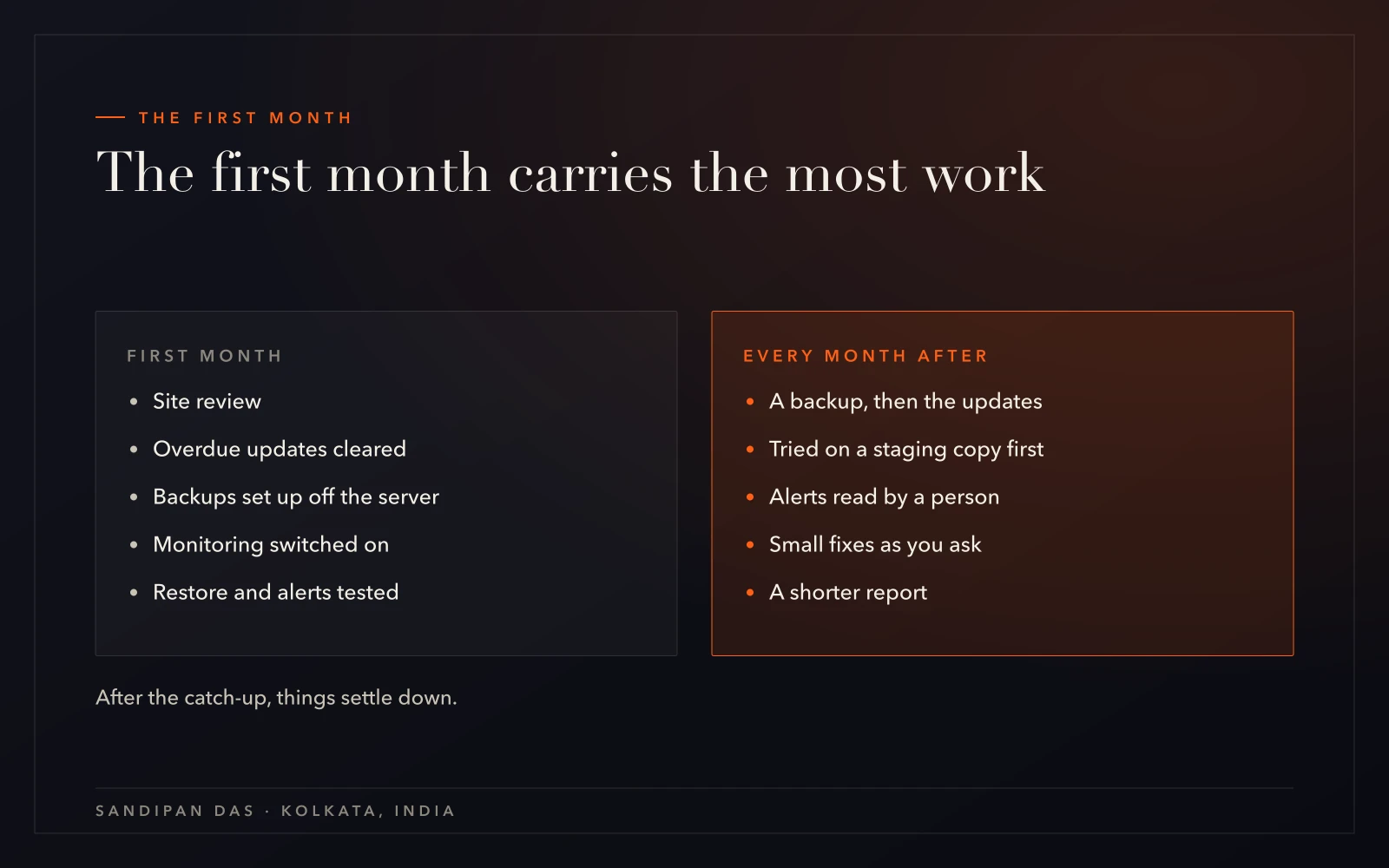
The part that takes longer than people expect is the first month. When updates have been skipped for many months, there's a backlog to clear before the weekly round can begin. That catch-up is heavier than any month that comes after it.
After that, things settle down.
So the first report is usually the longest one you'll read. Later reports are shorter, because most weeks are a backup, a round of updates and a check that the pages still work.
Comparison
Care plan, maintenance, management or support: which one fits?
Four of our services sound alike, and each one makes a different promise. The care plan is the package. Website maintenance is the routine technical work by itself. Website management adds business changes such as page edits, products and content. Website support gives you a developer team to send requests to.
For a business site you mean to keep, the care plan is usually the right place to start. It already holds the maintenance, and it gives you a team to ask. Choose management when the site changes every week, and support when you have your own list of jobs for a developer.
| CRITERION | What it promises | Usually right when |
|---|---|---|
| Website care plan | The full package under one scope, with a report every month | You want one plan and one report for a site you're keeping |
| Website maintenance | The technical routine: a backup, tested updates, a check afterwards | The site mainly needs to stay current and safe to update |
| Website management | The routine plus business changes to pages, products and content | The site changes often and you'd rather not make the edits |
| Website support | A team of developers you send requests to | You already know the jobs and want someone to do them |
Client feedback
Three clients who'd work with us again
“This is the second website he has created for us. He is professional and communicative and delivers beautiful work quickly.”
“Very professional Team and well prepared. I will definitly hire him and the team again.”
“Sandipan was fantastic to work with. He was professional, responsive, and skilled. I will recommend him and most likely use his services again.”
Pricing
How website care plans for small business sites are priced
The scope you sign decides what the plan costs each month. Its lines come out of the review of your site. How a scope gets built walks through the parts that go into one.
A store, or a site that's far behind on updates, carries more lines than a small site that's already current.
Bigger jobs, like moving hosts or adding a feature, get their own quote before work starts. Work on rankings sits with SEO services.
Next step
See what your site needs before a plan starts
Run the free WordPress site check first, then book a call with the result in hand. The opening lines of your care plan come out of that conversation.
What is a website care plan?
- A website care plan is one written scope that holds all of a site's routine upkeep. Updates run weekly, each after a backup. Copies are stored off the server, and a restore is tested. Alerts reach a person, small fixes are included, and a report arrives every month.
Is website care and maintenance the same thing?
- Website care and maintenance overlap, but they aren't the same thing. Website maintenance is the weekly technical round: a backup, tested updates and a check of the pages. A care plan holds that round and adds monitoring, small fixes and content edits, all under one signed scope.
Do I need a care plan when my hosting company already backs up the site?
- A host's backup is useful, and a care plan still adds what that copy leaves out. The plan keeps a copy away from the server, proves a restore on a spare copy, runs the weekly updates and puts a person on the alerts.
Does a WordPress website care plan cover WooCommerce stores too?
- A WordPress website care plan covers the core, the plugins and the theme, and WooCommerce stores go on the same kind of plan. Next.js sites and Node apps are covered as well, with their packages on the update list. Wix and Squarespace sites are outside the work, because neither gives access to the files.
Who do I contact when something on my site looks wrong?
- Support is the whole team, not one person — reach us any time, and someone picks it up. The team works on your schedule, in your time zone. Whatever you notice goes onto the plan's list for the team to look into.
Published · Updated