
hire a Next.js developer
Hire a Next.js developer to build the whole app, from React pages to the Node API
React on the front, Node and MongoDB behind it, and Next.js rendering every public page on the server: that's the stack my team builds with.
- Discovery call and a written scope: routes, data, integrations, deployment
- Design from your Figma, brand or a reference site — homepage approved first
- App Router build, with a CMS or admin panel where content changes often
- Node route handlers, auth, MongoDB — documented and tested
- Deployment on Vercel or your server, DNS with you on the call, analytics, structured data
- Repository in your GitHub, runbook, a fix window after launch

Try it
Two builds of the same page. Turn JavaScript off.
Left: the page rendered in the browser. Right: the same page rendered on the server by Next.js. Switch JavaScript off — the way Google's first fetch and a slow phone see a page — and watch which one is still there.
Rewiring done right, first time
Get a quoteRewiring done right, first time
Get a quoteWith JavaScript on, both look the same.
It's the same test the free SEO checker runs on a page.
Overview
Hire a Next.js developer for the whole stack, front to back
When you hire a Next.js developer from my team, I'm the one accountable for the whole stack. That covers the React front-end, the server-rendered pages, the route handlers and middleware on Node, the MongoDB behind them and the deployment on Vercel or your own server. Three developers on the team join in when the scope needs more hands.
The Next.js service page covers the build itself in full, from the data model to deployment.
I answer for all of it.
- The whole stack: App Router, server components, route handlers, MongoDB and deployment
- React pages, a Node API and the database in one scope
- Logins, roles and payments where the app needs them
- A written scope, a preview URL and a runbook
Why it matters
What you can check on a Next.js build from my team
Open any public page on a build of mine, switch JavaScript off and reload, and it's still there. The server sends it as finished HTML, so Google's first fetch reads it in full. That's the first item on my release list, and no public route reaches your preview until it passes. The free SEO checker reads a page the same way.
The code sits in your own GitHub account from the first commit, with a runbook that covers deploys, rollbacks and where the environment variables are kept. When a dependency needs a security update, it's covered by a retainer, or your developers take it on with the runbook.
And you'll get a straight answer on the stack. For a five-page brochure site, I'll recommend WordPress, which my team builds as well.
- JavaScript off: every public page still there
- The repository in your GitHub, with a runbook
- A straight recommendation on the stack
What the research says
How load time changes what mobile visitors do
Google measured real mobile visits, and Deloitte measured what a tenth of a second was worth across 37 brand sites. The green band is the load time Google calls good.
At 3.0 s a mobile visitor is +32% more likely to leave than at 1 s, as Google published it. Measure your page →
The rise after mobile pages got 0.1 seconds faster.
- Retail conversion rate8.4%
- Retail spend per order9.2%
- Travel conversion rate10.1%
These figures are other people’s research, quoted as published. Your own site’s numbers come from the free checks and the audit.
Comparison
Next.js or WordPress: which one your project needs
My team builds on both, so it's the site's job that decides.
| CRITERION | Next.js | WordPress |
|---|---|---|
| A few pages and a blog you edit yourself | ~More than the job needs | ✓The natural fit |
| Accounts, roles and a dashboard | ✓The natural fit | ~Better as its own app |
| Pages that draw fast on a phone | ✓Light by default | ✓With a light theme and caching |
| A shop with products you manage | ~Custom, for an unusual checkout | ✓WooCommerce |
| An API other systems call | ✓Route handlers on Node | ~A separate back-end |
| Content edited day to day | ✓A CMS or admin panel we build | ✓You, in the editor |
- A few pages and a blog
- A shop you run yourself
- Speed on a phoneboth
- Logins and dashboards
- An API for other systems
What a scope from me looks like
A sample scope for a Next.js build with a client area
Included
- Discovery call and a written scope: routes, data, integrations, deployment
- Design from your Figma, brand or a reference site — homepage approved first
- App Router build, with a CMS or admin panel where content changes often
- Node route handlers, auth, MongoDB — documented and tested
- Deployment on Vercel or your server, DNS with you on the call, analytics, structured data
- Repository in your GitHub, runbook, a fix window after launch
Phase two
- Payments, a portal, an API other systems call
- AI features inside the app
- A care retainer for dependency updates and monitoring
Not doing
- A launch before your sign-off
A Next.js scope names the routes, the data, the integrations and where the app is deployed. Each one is a line with a number, and anything you add later arrives as a new line.
If the call shows WordPress suits you better, I'll write the scope for WordPress instead.
Process
How hiring a Next.js developer runs
You make the decisions and supply the keys; the team builds, tests and deploys.
- 1
$ run step-01 --kick-off-call
Kick-off call
› What the app must do, who logs in and what it connects to. If WordPress is the better stack, you'll hear it here.
? input Tell me the goal, the users and the systems it talks to.
✓ A recommendation on the stack, and a rough range
- 2
$ run step-02 --routes-and-roles-scoped
Routes and roles, scoped
› Every route, role and integration gets a line with a number. You'll get the data model as a diagram you can read.
? input Decide what's in phase one.
✓ A scope you sign off
- 3
$ run step-03 --build-previewed
Build, previewed
› It's built on a staging URL that refreshes as the work goes on, and the API is tested with real data.
? input Approve the homepage; supply API keys and sample data.
✓ A preview URL to open any time
- 4
$ run step-04 --testing-on-your-phone
Testing on your phone
› Try the logins and click around the app on your phone. Anything that's wrong is fixed and checked again on a real handset.
? input Note the changes in the thread.
✓ Every fix logged and confirmed
- 5
$ run step-05 --deploy-and-hand-over
Deploy and hand over
› Deployed to Vercel or your server, with you on the call for the DNS switch. You'll have the keys and the runbook at handover.
? input Be on the launch call and give the sign-off.
✓ The live app, your keys and the runbook
- 6
$ run step-06 --updates-and-monitoring --watch
Updates and monitoring
› A retainer keeps the dependencies current and the monitoring on, or your own developers can do it, and they'll have the runbook.
? input Choose the retainer or your own team.
✓ Monthly reports, or the runbook in your team's hands
- Kick-off callboth
- Routes and roles, scoped
- Build, previewed
- Testing on your phone
- Deploy and hand overboth
- Updates and monitoringboth
Tech stack
What a Next.js developer here works with
Every layer of the stack, kept current on the retainer.
| CRITERION | What I use | Why |
|---|---|---|
| Framework | Next.js (App Router), React | Streaming and caching when a page needs it |
| Language | TypeScript | Fewer bugs reach the browser |
| Styling | Tailwind CSS | Design tokens in one place; no CSS file per page |
| Data | MongoDB with Mongoose | Flexible documents for content and orders; managed Atlas or self-hosted |
| Auth | NextAuth with role-based areas | Admin, client and staff areas on one codebase |
| Hosting | Vercel, or Node on a server you run | Your call — I've deployed both |
| Code | Git, with a runbook | Any Next.js developer can pick it up |
A useful first step
Send a sketch of the screens and a list of who logs in. That's enough for a first conversation about routes, roles and what goes into phase one.
Case study
Next.js work, reviewed by the clients
SiteRacks Hosting is a US hosting company. My team built the marketing site, the plans and the sign-up path on React, Next.js, MongoDB and AWS in 2024. "Sandi was brilliant, easy to talk, always responsive, and made fantastic work with our website."
Eve Tech is a South African product catalogue with many products on every page, so the stack decides how quickly a phone shows them. The client wrote of "excellent problem-solving abilities" and "clear, concise, and prompt communication". Both sites are live and linked from the projects page.
Client feedback
What clients say
- ★★★★★
“Sandi was brilliant, easy to talk, always responsive, and made fantastic work with our website. I highly recommend and also will look to work with him again in the future.”
- ★★★★★
“The freelancer demonstrated excellent problem-solving abilities, tackling challenges head-on and coming up with innovative solutions, maintains clear, concise, and prompt communication.”
Handover day
The app is live, and every route is documented
The API runs on Node, and the database sits in your account. The runbook covers deploys, rollbacks and where each environment variable lives. When a dependency needs an update, the retainer handles it, or your own developers follow the runbook.
- 900+ projects
- since 2017
- 4.9★
- 400+ five-star reviews on Fiverr
- 9+ years
- building WordPress and Next.js sites
Support is the whole team, not one person — reach us any time, and someone picks it up.
“The freelancer demonstrated excellent problem-solving abilities, tackling challenges head-on and coming up with innovative solutions, maintains clear, concise, and prompt communication. Any questions or concerns I had were addressed quickly and professionally.”
Schedule a Meeting
Bring the routes and the people who'll log in, even as a rough list. We'll work out what phase one covers.


A real office, real people
Led by me, built with my team — in Kolkata, India.
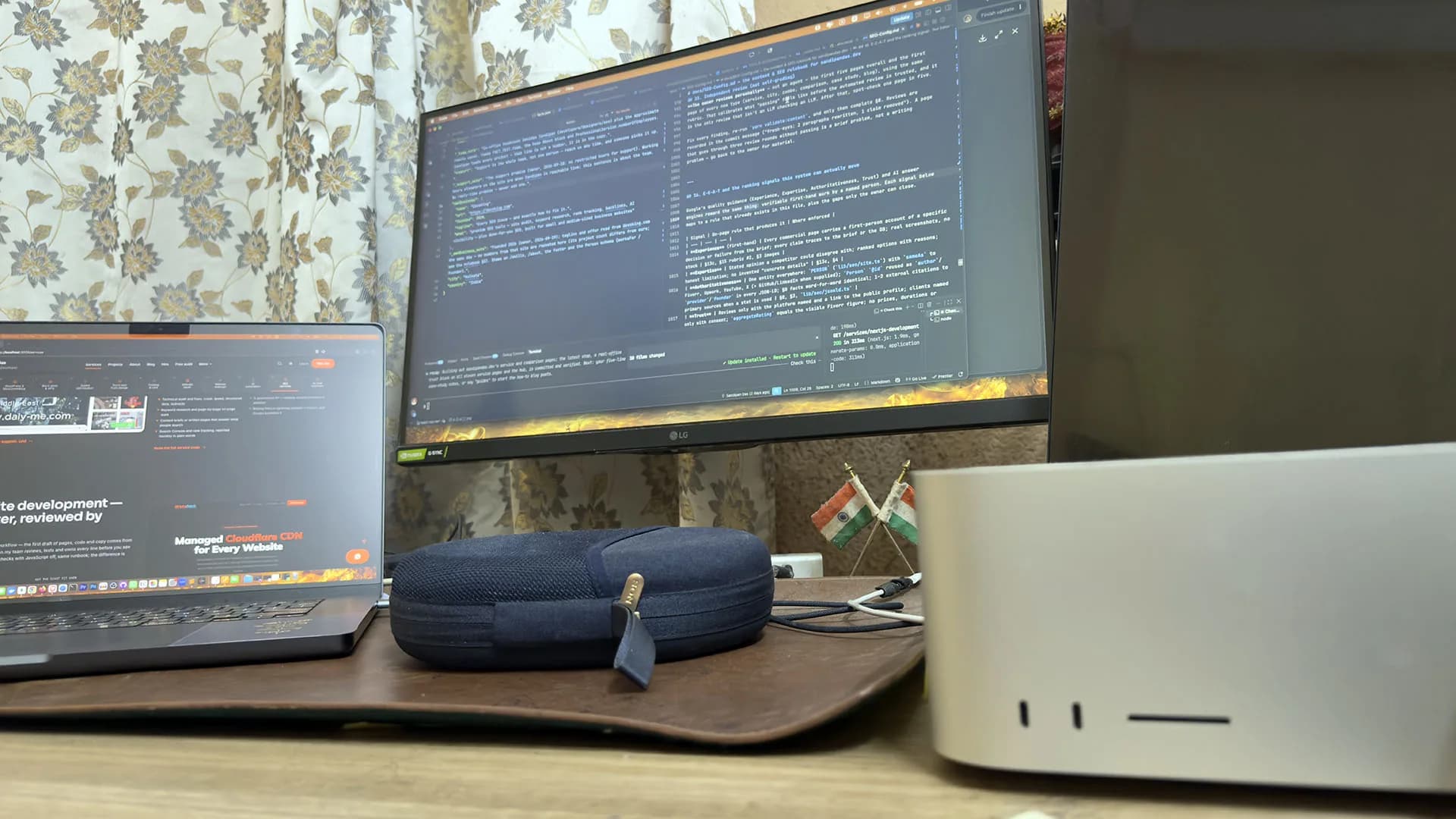
The team: three developers, a designer and three SEO specialists in the Kolkata, India office, plus around six people working remotely. The Next.js work is mine and the developers', and it's built at these desks, route by route, before you see a preview.

Sandipan Das
You talk to me; I’m the one accountable for the work.
- Availability
- The team works on your schedule, in your time zone.
- Support
- Support is the whole team, not one person — reach us any time, and someone picks it up.
Pricing
How hiring a Next.js developer is priced
Each route, feature and integration is a line with a number, written before day one.
Integrations get the most care in a scope. Every third-party API has its own edge cases, so each one's a separate line that's tested on its own.
The quote page shows how a scope becomes a number, and the Next.js service page has the build in detail.
- Scope: routes, features, integrations — a number per line
- Milestones tied to the scope's lines
- Integrations: one line each, tested on their own
Next step
Your app, on a first call
Bring the idea, the Figma file or the app you have now. You'll leave with a route list, a rough range and a clear view on whether Next.js suits it.
What can I check on a build from a Next.js developer for hire here?
- You can check three things on a Next.js build of mine before you hire. Open a live one from the projects page on your phone, and you'll see it draw straight away. Then read the client reviews beside it. And after launch, a retainer keeps the dependencies current, or your developers do it with the runbook.
What does a freelance Next.js developer leading a team give me?
- A freelance Next.js developer leading a team gives you one accountable person for the whole stack, with three developers on the team for the larger parts of a scope. I'm your contact at every stage, and the same team picks up the app when it needs changing later.
Can I hire a Next.js developer for a web app as well as a website?
- You can hire a Next.js developer here for a web app with logins, roles and payments. The React pages are the part your users see. The route handlers, the auth and the MongoDB database behind them sit in the same scope and the same repository.
Why hire a React and Next.js developer for a site that has to be found?
- A React and Next.js developer can render each public page on the server, so it arrives as finished HTML. A phone shows that page straight away, and Google reads it on the first request. For a site that has to be found in search, that's the reason to build on Next.js.
Do you work as a Next.js developer in India for US and UK companies?
- Yes. I lead a Next.js team in Kolkata, India, and US and UK companies hire us for apps and sites. Of my 900+ projects completed, the largest share by far went to the US: 600+ projects for US clients. The team works on your schedule, in your time zone, and you follow every build on its own staging link.
What does a Next.js expert know about rendering and deployment?
- A Next.js expert knows when a page should stream, cache or stay static, and builds on the App Router's data model. My team has deployed to Vercel and to plain Node servers, and the scope picks between them based on who will run the app.
Published · Updated