
website support services
Website support services: a team of developers to send your requests to
- Requests by message, picked up by a developer on the team
- Small fixes and content changes, up to the limit agreed at the start
- Change requests worked into the next week's round
- A fresh backup before each change, and a staging copy to try it on
- Answers to questions about how the site works
- A monthly report of the requests handled and what is due next
Overview
How website support services work from one request to the next
Website support services give a site you already have a developer team to send things to. You write in with the request. A developer on the team handles it inside the scope you signed, and a bigger job is quoted before any work starts.
It works like having a website developer for hire, except the request goes to the whole team. Three developers, a designer and three SEO specialists in the Kolkata, India office, plus around six people working remotely, form the team. I lead every project the team takes on.
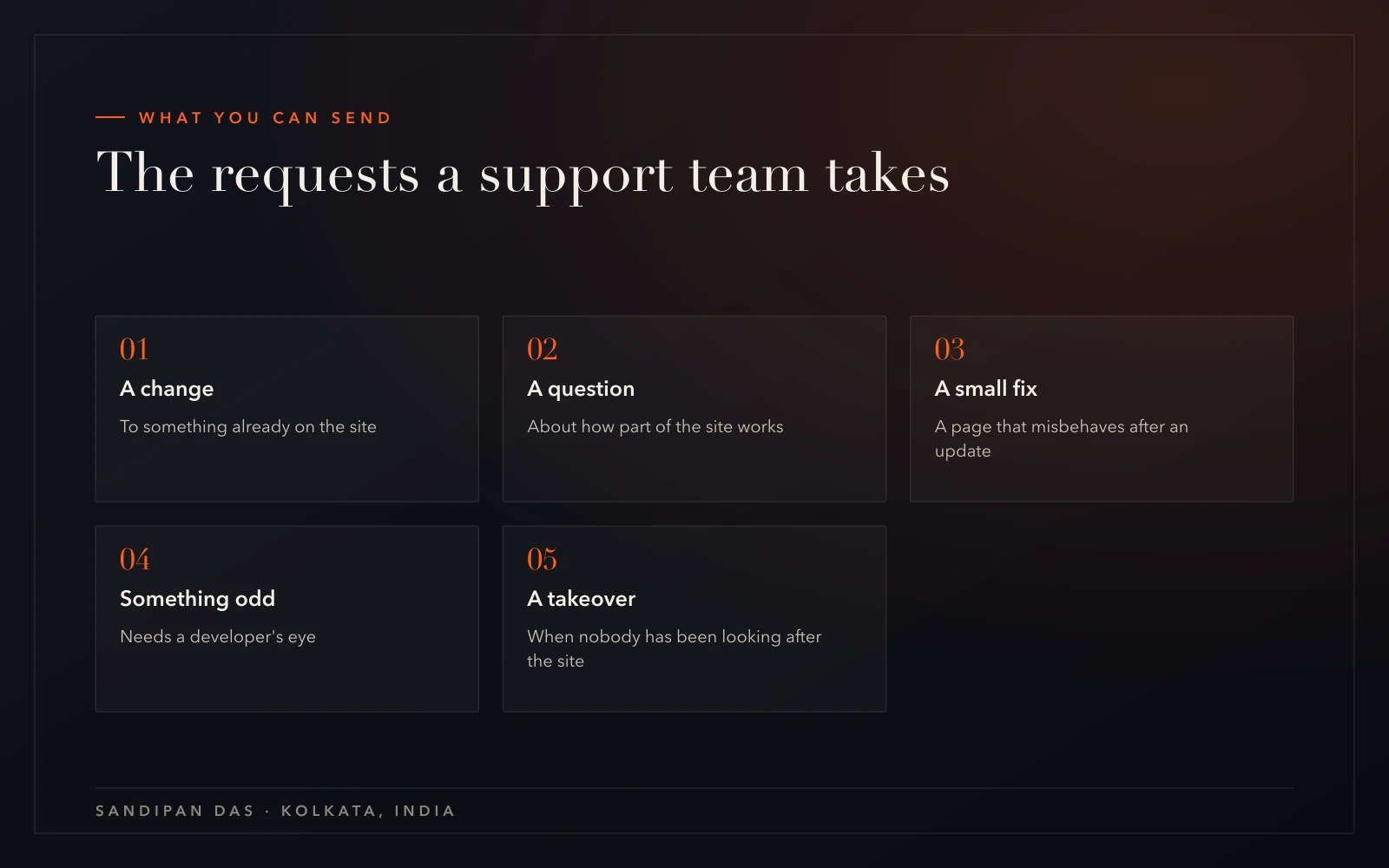
You can send any of these:
- A change to something already on the site
- A question about how part of the site works
- A small fix, such as a page that misbehaves after an update
- Something that looks odd and needs a developer's eye
- A takeover, when nobody has been looking after the site
What a scope from me looks like
A sample support scope, as you would sign it
Included
- Requests by message, picked up by a developer on the team
- Small fixes and content changes, up to the limit agreed at the start
- Change requests worked into the next week's round
- A fresh backup before each change, and a staging copy to try it on
- Answers to questions about how the site works
- A monthly report of the requests handled and what is due next
Phase two
- A request that grows into a new feature
- A redesign, or new sections
- A move to a new host
- Ranking work, through SEO services
Not doing
- Support for Wix or Squarespace sites
The scope is the agreement. It says what a request can cover and what gets a quote of its own.
One broken thing doesn't need a plan. It goes through website repair, where each fix is priced separately.
Process
From the first request to a regular rhythm
Support starts with knowing the site, because a request can't be handled safely on a site nobody has read. After that, requests simply flow into the weekly round.
- 01
Telling us about the site
You say what the site runs on, who built it and what keeps coming up. That decides whether a support plan or a one-off fix suits you better.- You
- Share the platform, the host and the requests you already have in mind.
- Get
- A straight answer on whether a support plan fits
- 02
Logins, then a written read
The team starts with the logins. Then it writes down what it finds on the site, plugin by plugin, along with the theme, the hosting and the licences.- You
- Admin, hosting and domain logins, plus the old developer's notes if there are any.
- Get
- A written read of the site
- 03
The scope you sign
The read turns into a written scope. It says which requests fit inside the plan and what is quoted separately.- You
- Read it, ask about anything unclear, and sign.
- Get
- A signed support scope
- 04
A safe place to make changes
Backups are kept away from the server, and one is restored onto a spare copy as a test. Changes get a staging copy to land on first.- You
- Confirm the spare copy looks like the live site.
- Get
- A tested restore and a staging copy
- 05
Your first requests
You send the first batch. Each request is made on the staging copy and checked before it goes live.- You
- Send the requests, with any text or images they need.
- Get
- The first requests done and live
- 06ongoing
Requests as they come
Anything new you send joins the next batch of changes, which begins with a fresh backup. A monthly report lists everything handled.- You
- Send anything you want changed, asked about or looked at.
- Get
- The monthly report of requests handled
- Telling us about the site
- Logins, then a written read
- The scope you signboth
- A safe place to make changes
- Your first requests
- Requests as they come
Why it matters
Small changes ride the weekly round
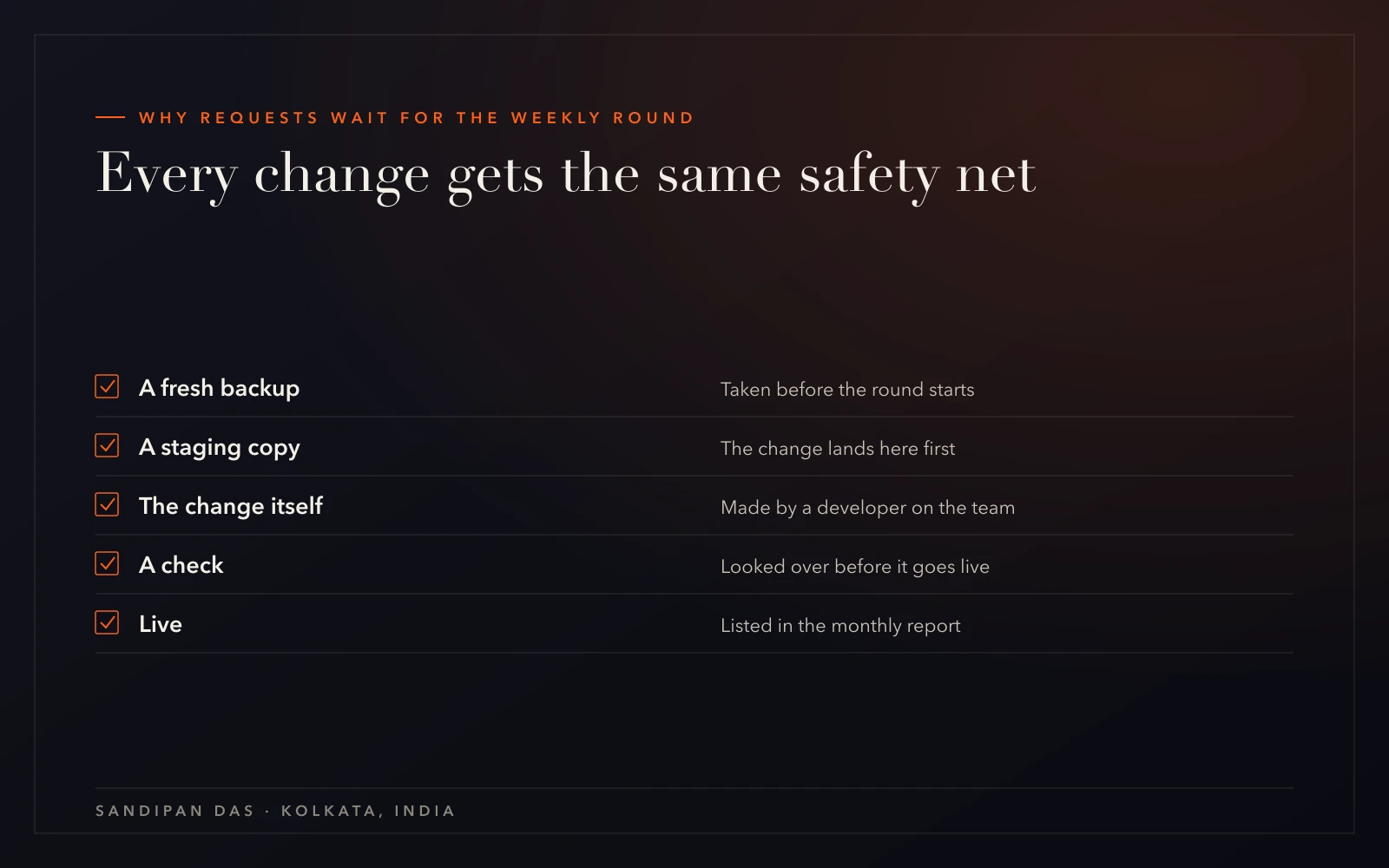
My approach is to batch change requests into the weekly round rather than push each one live the moment it arrives. Every round starts with a fresh backup and runs on a staging copy. So each change gets the same safety net, however small it looks.
Taking over a site someone else built takes longer than people expect. The logins have to be found first, and the written read comes before the first request is touched.
Comparison
Support next to maintenance, management and a care plan
A steady stream of small, mixed requests is usually best served by support. When the requests are mostly about prices, pages and products, website management is the closer fit.
If you only want the updates and backups taken care of, look at website maintenance. The website care plan bundles it all into one plan.
| CRITERION | The service | What you get |
|---|---|---|
| A team to send requests to as they come up | Website support | Changes, questions and small fixes handled inside a scope |
| The updates and backups done every week | Website maintenance | The technical routine, with a backup before each update |
| The site kept in step with the business | Website management | Upkeep plus edits to pages, text and products |
| Everything under one plan | Website care plan | Every part of the upkeep folded into a single plan |
Client feedback
Three clients who'd work with the team again
“This is the second website he has created for us. He is professional and communicative and delivers beautiful work quickly.”
“Very professional Team and well prepared. I will definitly hire him and the team again.”
“Sandipan was fantastic to work with. He was professional, responsive, and skilled. I will recommend him and most likely use his services again.”
Pricing
What shapes the cost of a website support retainer
A website support retainer is priced from its scope. The scope fixes how much small work fits into a month and which kinds of request it covers.
A request that outgrows the scope is quoted before anyone starts on it. It's your call whether it goes ahead.
How pricing works walks through the parts of a scope before you ever book a call.
Next step
Talk through the requests you have been saving up
Book a call and run through what the site needs. The support scope gets written around those requests.
What kind of tasks can I send to a website support team?
- A website support team takes changes to the site, questions about how it works, small fixes and anything that looks wrong. Each request is handled inside the written scope. A request that grows into a new feature gets its own quote before the work is done.
Do I need a monthly plan, or can I ask for one-off help?
- One-off help doesn't need a monthly plan. A single broken thing goes through website repair, where every fix is priced separately. A monthly support plan suits a site that sends a steady stream of small requests.
Can you support a site another developer built?
- Sites built by another developer can be taken over. The takeover starts with the logins, followed by a written read of the plugins, theme, hosting and licences, so the team knows the site before the first request.
Do your WordPress support services cover other platforms too?
- WordPress support services cover WordPress and WooCommerce sites, and the team also supports Next.js and Node sites. Wix and Squarespace are the exception. Those two platforms keep their files closed to developers, so the team can't support them.
Can a business in the US, UK or Canada use a support plan?
- A business in the US, UK or Canada can use a support plan the same way a client in India does. The team works on your schedule, in your time zone. Requests go by message to the team in Kolkata, India.
Published · Updated