
SEO for Developers · Business Tips
Best AI SEO tools
A buying order rather than a ranking — DevsKing, the SEO tool company I founded, makes one of these tools. Here is how I'd choose: three tiers in the order to buy them, five questions for any tool that says "AI", and the one condition every one of them depends on.

The best AI SEO tools, in one paragraph
The best AI SEO tools are the ones whose output a person on your side actually reads. Three tiers, in order: Google's free tools first — Search Console, PageSpeed Insights, the Rich Results Test — free one-job checkers second, a paid AI-assisted suite last, judged by five questions: the job, the model, the fallback, the cost cap, the reader. Connect the first before you buy the third.
A word on why this isn't a ranked list. DevsKing, the SEO tool company I founded, builds one of the paid tools, so a ranking from me would carry that tie. The products also change often. How to choose stays the same, and that's what follows.
Three tiers, in the order to buy them
Tier one is free and from Google; tier two is free and does one job each; tier three is paid and has AI inside. The order is the advice.
Tier one — Google's own tools. Search Console tells you which pages Google has indexed, which queries bring people, and where the page sits for each. PageSpeed Insights measures how the page loads on a phone. The Rich Results Test checks whether your structured data — the hidden markup that describes a page to search engines — is valid. No AI in any of them, and they are the only source of Google's actual numbers. Connect Search Console before you spend a rupee on anything else. It is free, it is plain, and every later number is read against it.
Tier two — free checkers that do one job. The SEO checker, speed check, robots & sitemap checker, schema generator and SERP preview on this site each answer one question, in your browser, with no account. They are how my team starts a look at any site, and they find the basics — not indexed, text behind JavaScript, two H1s, a sitemap full of redirects — that come first, whatever runs on top.
Tier three — a paid, AI-assisted suite. This is where a model earns its keep: reading a long audit into a fix list in plain English, grouping a long keyword export into topics, tracking rankings, checking whether the site is cited across ChatGPT, Gemini and Perplexity. DevsKing, the SEO tool company I founded, makes one of these — built on Claude, Gemini and ChatGPT — and the rest of this post is the test I hold it to, the same test I'd put to any tool.
Five questions to ask any AI SEO tool
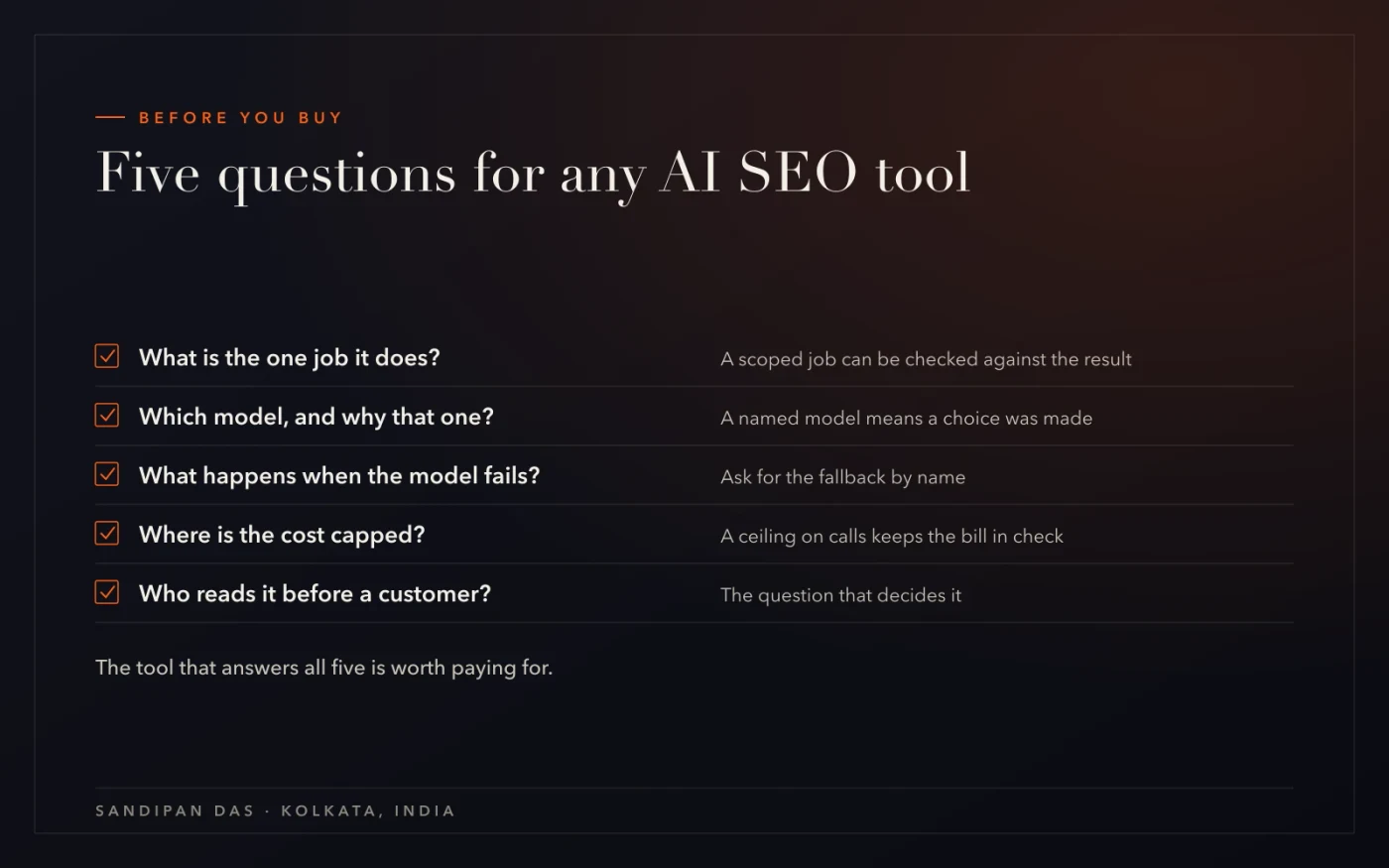
These are the five parts every AI feature I've shipped has to have, turned into questions for a buyer. The tool that answers all five is worth paying for, and the fifth is the one to press hardest.
- What is the one job it does? — "Everything" is not an answer. "Turns the audit into a fix list" is. A tool with one scoped job can be checked against the result; a tool with a vague one can only be trusted, and trust is not a process.
- Which model, and why that one? — "AI-powered" on its own tells you little. A name — Claude, Gemini, ChatGPT — means a choice was made, and the choice tells you something about what the tool is good at and how it fails.
- What happens when the model fails? — Models time out and go down. Either there is a second model behind the first, or there is a blank screen on the day you need the report. Ask for the fallback by name.
- Where is the cost capped? — Every model call costs money. A plan without a ceiling on calls is a bill with no ceiling, and it runs away on the day someone bulk-publishes. Ask to see the cap written on the pricing page.
- Who reads the output before a customer does? — The question that decides it. If the answer is "nobody" — the tool writes the pages and they go live — the tool is the writer and the writer is unread. Google's guidance on generative-AI content judges the result, not the tool; unread output is how a site ends up saying things the business never said.
What the tool says, and what you still have to do
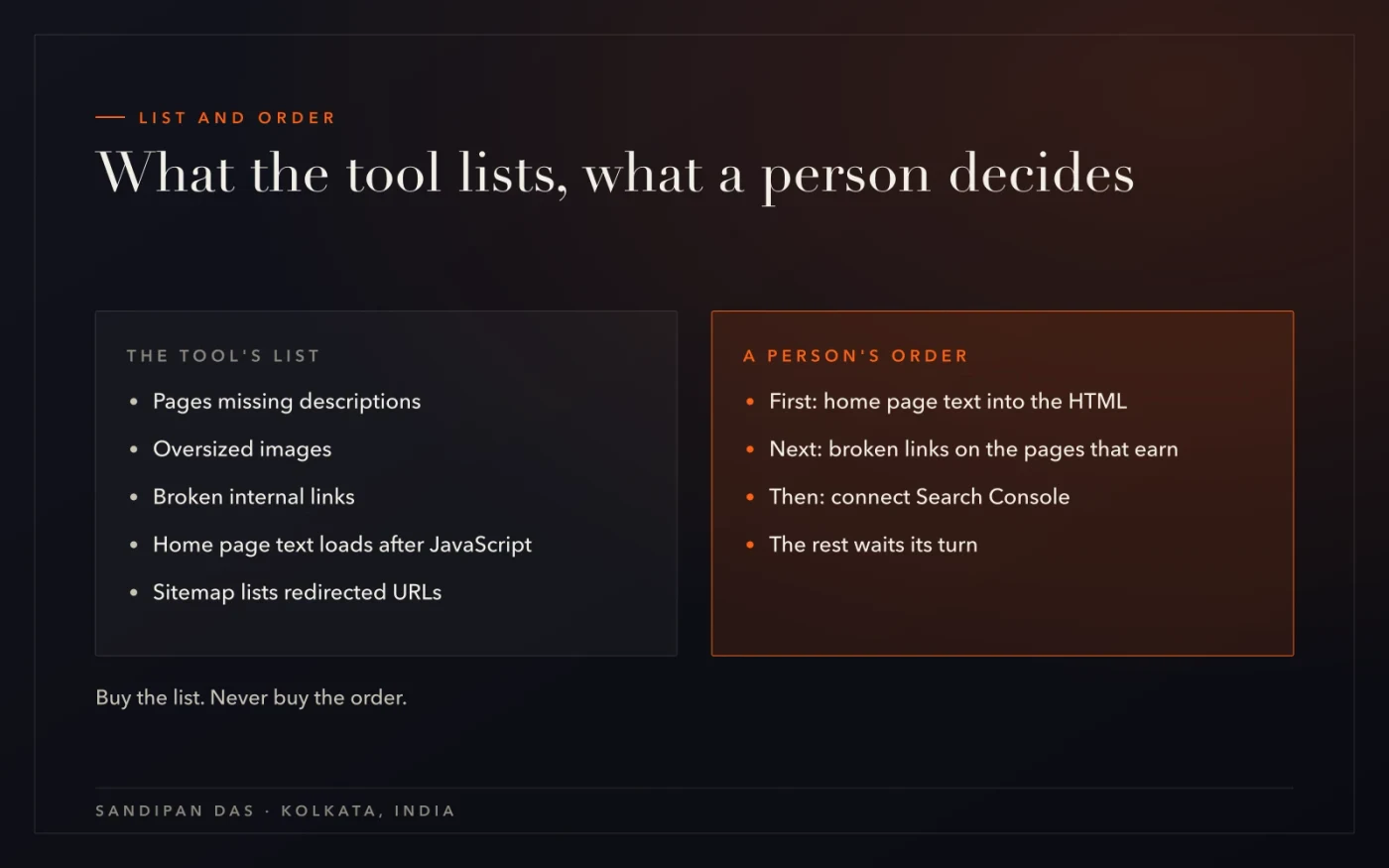
A good tool lists everything; that is its job. Which three items matter to your business this month is a call a person makes, because it needs to know the business.
Here is the shape of it, with made-up numbers. An audit comes back with a couple of hundred issues: pages missing descriptions, oversized images, a handful of broken internal links, a home page whose text loads after JavaScript, a sitemap listing redirected URLs, no Search Console property connected. Every line is true. The tool has done its work.
Then a person picks three. The home page first, because until its text is in the HTML nothing else counts. The broken links next, because they sit on the pages that earn the money. Then connect Search Console, so next month has numbers. The other two hundred wait — some until next quarter, some forever. The tool drafted the list. A person chose the order. Buy the list; never buy the order, because the order has to know your business.
What people get wrong when buying AI SEO tools
Four mistakes, in the order I meet them.
- Choosing by feature count. Forty features and nobody reading the output loses to three features and a person who does. The fifth question beats the brochure.
- Paying for a suite before Search Console is connected. The suite will tell you what Google would have told you for free — and Google's numbers are the ones that count.
- Trusting a "content score" over whether the page says something true. A score measures how a page resembles other pages. Readers, and the engines imitating them, want the page that knows something the others don't.
- Letting a tool publish. Drafts are fine; unread drafts going live are how a site ends up with claims nobody made. The reader is the feature.
Buy the list. Never buy the order. And before you buy anything, connect Search Console — it's free, and it's the number everything else is measured against.
Read next
The thinking behind the five questions, the free checkers, and the done-for-you version.
- The AEO guide — answer engine optimisation, start to finish
- What is AI SEO? — two meanings, one honest answer
- What is AEO? — answer engine optimisation, explained
- All free tools
- AI automation — the five-part pattern, built into your product
- SEO services — done for you
- Freelance SEO consultant — the plan
If you'd rather have someone do this
Start at tier two: run the free SEO checker on the page that earns you the most and you'll see which basics are missing before any tool is bought. If you'd rather have a team that uses the tools and still reads every line before it reaches you, the SEO consultant page is where that starts — and SEO services is the version where we run the tools for you. The whole method, all nine questions, is in the AEO guide.
Questions
Questions this post answers
How do you measure AI search visibility?
- By whether a page is cited — quoted as a source by ChatGPT, Gemini, Perplexity or an AI Overview for a given question — rather than by a position. A tier-three tool runs that check; Search Console shows the question-shaped queries next to it. Neither replaces a person deciding what to do about the answer.
How do you audit a website for AI search?
- Start with the ordinary audit — indexed, fast, text in the HTML, one H1 per page — because an engine can't cite what it can't fetch; the free checkers cover this. Then check each important page for a direct answer at the top and proof below it. A tool lists the issues; a person picks the three that matter first.
How is AI changing SEO?
- The work is the same — indexed, fast, honest, worth reading — and the tools do the slow parts faster: reading an audit into a fix list, grouping keywords, drafting. What stays the same is that a person sets the priorities and reads every line a customer will read, which is the step Google's guidance on generative-AI content puts weight on.
Are free SEO tools enough for a small business?
- For the basics, yes: Search Console, PageSpeed Insights and a handful of one-job checkers find the problems that stop a small site from being found at all. A paid AI suite earns its place once those are fixed and someone has the time to read what it produces.